
5 Steps to Create a Life You Love (Without Trying to Fix Yourself First)
There is a version of your life that feels right. Not perfect. Just right. Meaningful work, real connection, financial ease, a body you feel good in.
Most people want that. And most people spend years trying to get there by fixing everything that seems to be in the way.
The problem is that fixing keeps your focus on the problem. And where your attention goes, your energy follows (Higgins, 1996). A life organized around solving problems rarely becomes the life you actually want. It just becomes a more managed version of the one you have.
Here is a different approach. Five steps that shift you from problem-solving mode into a creative structure, where the life you want becomes something you build rather than something you earn by suffering enough.
Step 1: Choose a True Goal
A true goal is not a reaction to a problem. It is not "I want to stop feeling anxious" or "I want to get out of debt." Those are understandable, but they are problem-focused. They point away from something rather than toward something.
A true goal is chosen simply because you want it. Not to complete yourself, fix yourself, or prove something to anyone. Just because it matters to you.
Research on goal-setting consistently shows that approach goals (moving toward something desired) produce more sustained motivation and better outcomes than avoidance goals (moving away from something unwanted) (Elliot & Fryer, 2008). Knowing what you want, clearly and specifically, is the starting point for everything that follows.

Step 2: Create Structural Tension
Structural tension is the gap between where you are now and where you want to be. When held clearly, that gap becomes a creative force. It naturally draws you forward.
This concept, developed by author and teacher Robert Fritz, describes how a creative structure works differently from a problem-solving one. In a creative structure, the tension between your current reality and your desired outcome generates momentum without requiring constant willpower or internal struggle.
You can read more about this framework in Fritz's book, The Path of Least Resistance. The core idea: your structure determines your behavior more than your intentions do.
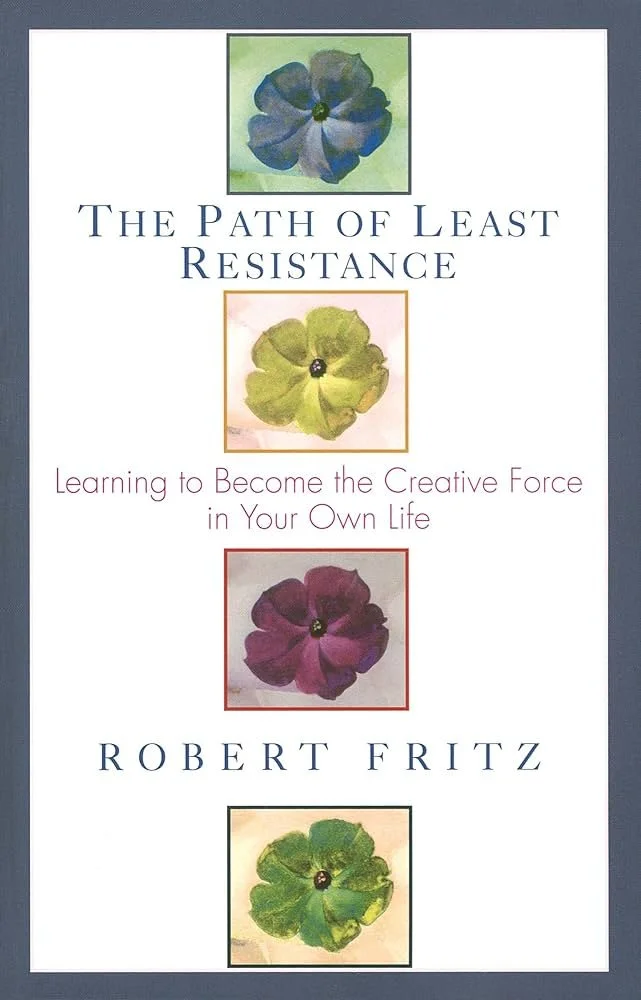
The Path of Least Resistance by Robert Fritz
Step 3: Be It to See It
Traditional personal development often focuses on healing the past or fixing current problems. The limitation of that approach is that it keeps you emotionally anchored to who you have been, rather than opening space for who you are becoming.
This step is about practicing the emotional state of the person you want to be before the external evidence shows up. Neuroscience research supports this: the brain responds to vividly imagined experiences similarly to real ones, which means deliberately rehearsing a new emotional identity begins to rewire the neural pathways associated with old patterns (Dispenza, 2012).

You do not fix your way into a new identity. You practice your way into one.
Step 4: Release, Recode, and Replace Old Patterns
Even with a clear goal and a creative structure, old beliefs and behaviors can block the path forward. These are not character flaws. They are patterns formed over years of experience, often running automatically below conscious awareness.
This step involves identifying the specific beliefs and emotional patterns that create resistance, releasing the charge they carry, and replacing them with new ones aligned with your true goal. Approaches like EMDR (Eye Movement Desensitization and Reprocessing) are clinically supported for helping the brain process and release deeply held patterns that talk therapy alone does not always reach.
You can learn more about how EMDR works at the EMDR International Association.
Step 5: Take Aligned Action
Aligned action means taking steps that are oriented toward your true goal rather than away from your current problems. It does not have to be large. Small, consistent actions taken in the right direction create momentum and, over time, new neural pathways.
The key difference from ordinary action is perspective. Aligned action is taken from the mindset of the person you are becoming, not the person you are trying to leave behind. That shift changes the quality of every decision you make.
There is no transformation without action. But the action has to point somewhere worth going.
The Shift That Changes Everything
These five steps are not a quick fix. They are a reorientation: from a life spent managing problems to a life spent creating what you actually want.
You are not broken. You do not need to earn a better life by suffering enough or working hard enough on the wrong things. You need a clear goal, a creative structure, and the willingness to practice being the person you want to become.

The life you love is not waiting for you to fix everything first. It is waiting for you to start building.
References
Dispenza, J. (2012). Breaking the habit of being yourself. Hay House.
Elliot, A. J., & Fryer, J. W. (2008). The goal construct in psychology. In J. Y. Shah & W. L. Gardner (Eds.), Handbook of motivation science (pp. 235–250). Guilford Press.
Fritz, R. (1989). The path of least resistance. Ballantine Books.
Higgins, E. T. (1996). Knowledge activation: Accessibility, applicability, and salience. In E. T. Higgins & A. W. Kruglanski (Eds.), Social psychology: Handbook of basic principles (pp. 133–168). Guilford Press.