
Why We Keep Choosing the Same Kind of Love
Almost everyone I have worked with over the years has, at some point, said a version of the same sentence. Why do I keep ending up in the same kind of relationship, even with completely different people?
Different names, different circumstances, and somehow the same dynamic. The same distance. The same anxiety. The same feeling of giving more than you receive, or being loved in a way that never quite lands.
This is not bad luck, and it is not a character flaw. It is one of the most well-documented patterns in relationship psychology.

Attachment Is a Blueprint, Not a Preference
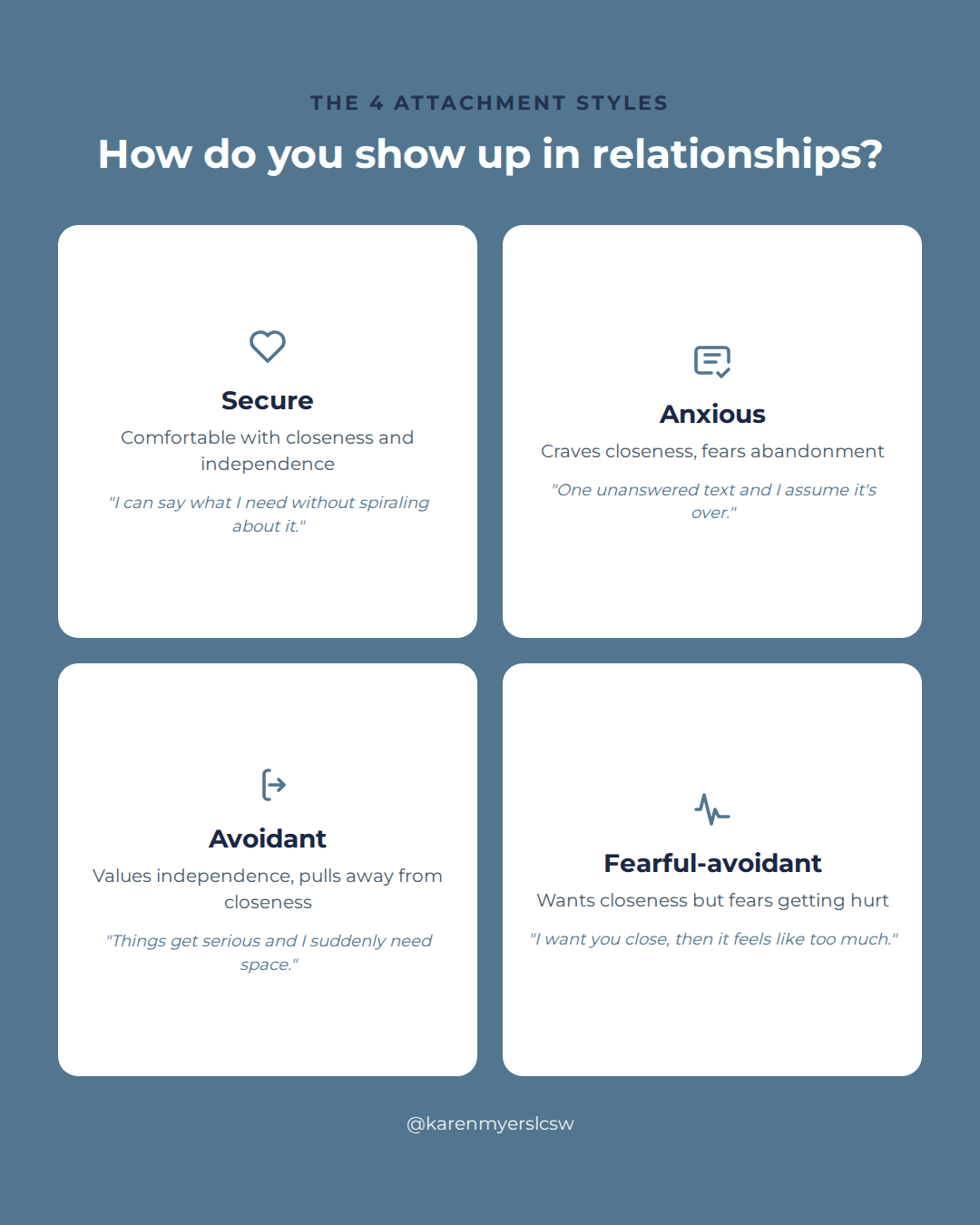
Foundational work by psychologists Cindy Hazan and Phillip Shaver applied attachment theory, originally developed to understand infant and caregiver bonds, to adult romantic relationships, and found that the same core attachment patterns, secure, anxious, and avoidant, show up remarkably consistently across a person's romantic history (Hazan & Shaver, 1987).
This means your attachment style is not really a preference you are choosing fresh each time. It is closer to a blueprint, formed early, that shapes what feels familiar, what feels safe, and even what feels like chemistry. People with an anxious attachment style, for example, often find themselves drawn to emotionally unavailable partners, not because they enjoy the anxiety, but because the pursuit of reassurance from someone withholding feels, unconsciously, like home.
Why Familiar Gets Mistaken for Right
The nervous system consistently favors the familiar over the healthy because familiar has historically meant survivable. This is why a relationship that recreates an old, even painful, dynamic can feel more like chemistry than a genuinely secure relationship does. Secure can feel unfamiliar, even boring, to a nervous system calibrated to anxiety or distance.
This does not mean you are doomed to repeat the pattern forever. Attachment researchers John Bowlby and later Mary Main introduced the concept of earned security, the finding that adults with insecure early attachment can develop secure attachment patterns later in life, most often through a combination of self-reflection and a genuinely secure relationship, whether romantic, therapeutic, or platonic (Main & Goldwyn, 1984). The blueprint can be redrawn. It usually takes conscious work and often outside support to do it.

What Self-Expansion Adds to the Picture
Psychologist Arthur Aron's self-expansion theory offers another useful lens. His research found that people are drawn to relationships that expand their sense of self, their skills, perspectives, and identity, and that relationships lacking this quality of growth tend to feel stagnant over time regardless of how stable they are (Aron, Aron, & Smollan, 1992).
This means a healthy relationship is not simply the absence of anxiety or distance. It is one where both people are genuinely growing, individually and together, rather than one person consistently shrinking to accommodate the other.
A Few Honest Questions
If a familiar pattern keeps showing up in your relationships, a few questions worth sitting with.
What did love look like in the environment you grew up in? Was it steady, or did you have to work for it?
Does the relationship you are in, or the ones you are drawn to, feel calm, or does it feel like a version of anxious pursuit that you have felt before?
Are you growing inside this relationship, or are you managing it?

You Are Not Doomed to Repeat It
The pattern was built early, often before you had any say in it. But it was built, which means it can be rebuilt, usually with support, patience, and a willingness to tolerate what secure love actually feels like before it starts to feel like home too.

The kind of love that keeps finding you is not fate. It is familiarity. And familiarity can change.
References
Aron, A., Aron, E. N., & Smollan, D. (1992). Inclusion of Other in the Self Scale and the structure of interpersonal closeness. Journal of Personality and Social Psychology, 63(4), 596–612.
Hazan, C., & Shaver, P. (1987). Romantic love conceptualized as an attachment process. Journal of Personality and Social Psychology, 52(3), 511–524.
Main, M., & Goldwyn, R. (1984). Predicting rejection of her infant from mother's representation of her own experience: Implications for the abused-abusing intergenerational cycle. Child Abuse & Neglect, 8(2), 203–217