
Why Your Identity Is Like Water (And What That Means for Change)
I want you to think about water for a moment.
Freeze it, and it becomes ice. Melt it, and it flows. Boil it, and it becomes steam. Freeze the steam, and it becomes ice again.
But through every single transformation, through every different form and structure, it is always H2O.
Your identity works exactly the same way.
You can freeze yourself in a rigid, defended version of who you think you are. You can melt into something more fluid and open. You can evaporate into something almost unrecognizable from who you used to be.
But the core of who you are never changes. What changes is the structure you are running it through.
That one insight changes everything about how we approach personal growth.

The Problem With How We Think About Identity
Most people approach personal development as if identity is a problem to be fixed. They focus on what is wrong with how they think, how they feel, or how they behave, and they try to repair it.
The therapy.
The journaling.
The affirmations.
The mindset work.
All of it oriented around identifying what is broken and making it better.
But here is what I have observed in 30+ years of sitting with people in my office. The people who make the deepest and most lasting changes are not the ones who fixed themselves. They are the ones who shifted the structural orientation they were making decisions from.
There is a profound difference between those two things.
Research in cognitive neuroscience supports this. When we hold a belief about ourselves, whether positive or negative, it activates the ventromedial prefrontal cortex, the same region of the brain associated with our sense of self and identity (Sui & Gu, 2015). This means our beliefs are not just ideas we hold. They are woven into the neural architecture of who we are.

Asking someone to simply think differently, without addressing the deeper structural layer, is like asking water to stop being H2O.
What Structure Actually Means
When I talk about structure, I am not talking about routines or habits, although those matter. I am talking about the deeper orientation you are making every decision from.
There are two primary structures most people move through life from:
The problem-solving structure asks: what is wrong and how do I fix it? It organizes life around deficits. It keeps attention focused on what is missing, what is broken, what needs to be corrected before you can finally have what you want.
The creative structure asks: what do I want to create? It organizes life around possibility. It keeps attention focused on what you are building, what you are becoming, what you are moving toward.
Both structures can use the same person, the same history, the same ingredients. But they produce completely different results.
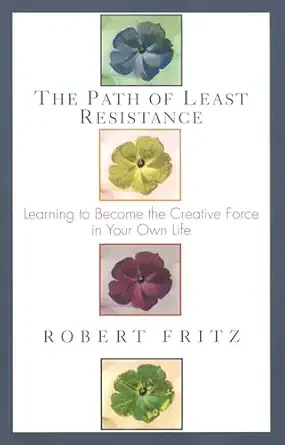
Robert Fritz, who spent decades studying the mechanics of creation and problem solving, identified this distinction as one of the most fundamental forces shaping human experience (Fritz, 1989). He found that people operating from a creative structure could use tension between their current reality and their desired outcome as a generative force, pulling them forward. People in a problem-solving structure, by contrast, were perpetually managing symptoms without ever resolving the underlying dynamic.
You Are Not Your Past Behavior
One of the most liberating things I can offer someone is this:
The patterns you have been repeating are not evidence of who you are. They are evidence of the structure you have been operating from.
The anxious person who keeps choosing unavailable partners is not fundamentally broken or unworthy of love. They are making decisions from a structure organized around scarcity and self-protection.
The capable professional who self-sabotages every time they get close to success is not fundamentally afraid of happiness. They are making decisions from a structure organized around the familiar, even when the familiar is painful.
Behavioral science consistently shows that human behavior is far more context-dependent and structurally driven than we tend to believe (Wood & Neal, 2007). Change the structure, and behavior follows naturally, without the heroic effort most people assume is required.
How to Work With Your Identity Instead of Against It
The shift is not about becoming someone new. It is about allowing the full expression of who you already are to move through a different structure.
Here is what that looks like in practice:
First, get honest about which structure you are currently operating from. Not which one you aspire to. Which one is actually running your daily decisions right now. Are you organizing your life around problems to solve or possibilities to create?
Second, identify your true goal. Not what you want to escape or avoid. What you actually want to create. This distinction matters more than most people realize.
Third, practice being the version of you that is already creating that. Not performing it. Not faking it. Actually inhabiting the emotional state, the beliefs, the behaviors of the person you are becoming, before the external evidence shows up.
Neuroscience shows us that vivid mental rehearsal drives the same structural neuroplasticity as physical practice (Pascual-Leone et al., 1995). When you mentally inhabit a state, your brain begins to physically wire the pathways to support it. This means practicing a new identity is not self-delusion. It is one of the most effective tools we have for creating real, structural change.
You Were Never the Problem
After years of this work, the thing I most want people to understand is this:
You are not broken. You never were.
You are H2O. You have always been H2O.
What is shifting is not who you are. It is the structure you are moving through.
And when that structure changes, everything else follows.

Not because you fixed yourself. Because you finally stopped trying to.
References
Fritz, R. (1989). The path of least resistance. Ballantine Books.
Pascual-Leone, A., Nguyet, D., Cohen, L. G., Brasil-Neto, J. P., Cammarota, A., & Hallett, M. (1995). Modulation of muscle responses evoked by transcranial magnetic stimulation during the acquisition of new fine motor skills. Journal of Neurophysiology, 74(3), 1037–1045.
Sui, J., & Gu, X. (2015). Self as object: Emerging trends in self research. Trends in Neurosciences, 38(9), 542–544.
Wood, W., & Neal, D. T. (2007). A new look at habits and the habit-goal interface. Psychological Review, 114(4), 843–863.